
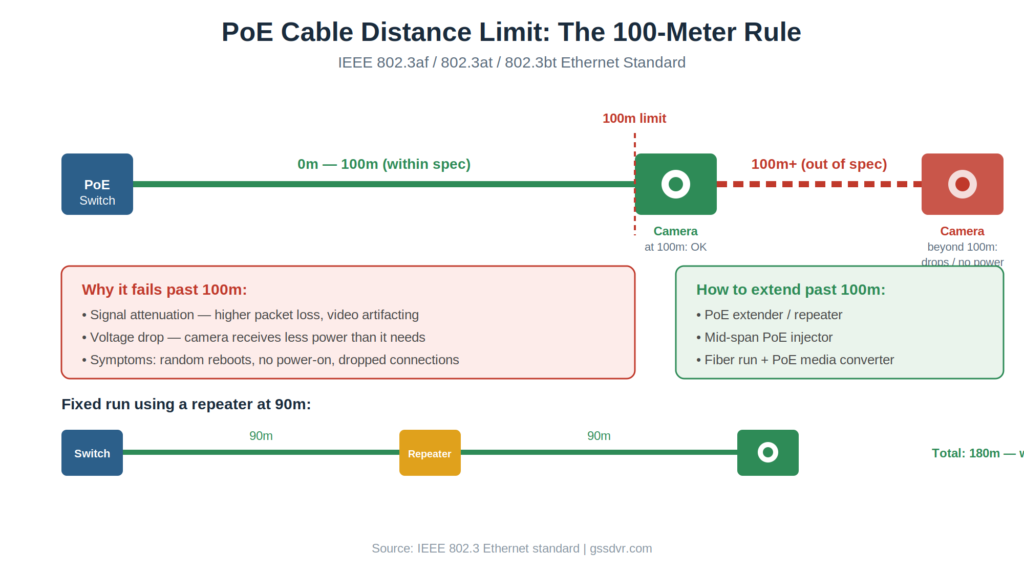
Quick answer: Standard PoE (802.3af/at/bt) over Cat5e/Cat6 cable is limited to 100 meters (328 feet) per run, per the IEEE 802.3 Ethernet standard. Beyond that, signal and power both degrade — video drops, cameras reboot randomly, or won’t power on at all. If your run is longer, you need a PoE extender/repeater, a mid-span injector closer to the camera, or a fiber run with a media converter at the end.
Why 100 Meters Is the Hard Limit
This isn’t a security-industry number — it’s inherited from the IEEE 802.3 Ethernet spec itself. Beyond 100m, two things break down together:
- Data signal attenuation. Ethernet’s electrical signal degrades over copper, and past 100m, packet loss and video artifacting become likely even if the camera still powers on — signal-to-noise ratio and bit error rate both fall outside spec beyond this distance.
- Voltage drop. PoE delivers power down the same copper pair as data. The longer the cable, the more voltage is lost to resistance before it reaches the camera. The original 802.3af standard delivers up to 12.95W to the device, but real-world budgets often shrink further with cable quality and distance, especially with thinner-gauge Cat5e.
This is why installers sometimes see a camera work fine at 90 meters but flake out, reboot loop, or lose IR/heater functionality at 110 meters — it’s not a bad cable run, it’s exceeding spec.
Your Options Past 100 Meters
For a deeper technical breakdown of each method (and when each makes sense on a real job), Planet Technology’s guide to extending PoE beyond 100 meters is a solid field reference.
| Option | Best for | Trade-off |
|---|---|---|
| PoE extender/repeater | Adding 100m to an existing run (drop it mid-cable) | Needs its own power source unless it’s passive; adds a point of failure |
| Mid-span PoE injector | Powering a camera from a closer switch/injector, run data separately | More install complexity, extra hardware cost |
| Fiber + PoE media converter | Long runs (500m+), outdoor/campus installs, EMI-heavy environments | Higher upfront cost, but no distance/power limit like copper |
| Higher-gauge cable (Cat6 vs Cat5e) | Marginal runs close to 100m | Doesn’t extend past the 100m spec — just improves signal quality within it |
A Common Mistake: Confusing “Rated Distance” with “Real-World Distance”
Cable and camera spec sheets often quote the ideal 100m figure, but real installs rarely hit that cleanly. Factors that shrink your effective distance:
- Cable quality — bargain Cat5e with thin copper strands loses more voltage than solid-core Cat6; NETGEAR’s cable length guide recommends sticking to ANSI/TIA-568 compliant cable with proper AWG conductors for reliable PoE runs.
- Number of connections/couplers in the run — every coupler or patch panel adds resistance.
- PoE class/wattage of the camera — a PTZ or heater-equipped camera pulling 25-30W (PoE++) has less margin than a basic 5W fixed camera.
- Ambient temperature — heat increases copper resistance, which matters for outdoor conduit runs in summer.
Rule of thumb: if you’re near 90-100 meters and running a higher-wattage camera (PTZ, heater, IR array), plan for a mid-span injector or extender rather than hoping the run holds up.
Bottom Line for Bidding a Job
Before quoting a job, map your longest camera run. Anything over ~80 meters (to leave margin) should get priced with an extender, injector, or fiber segment built in — not discovered as a problem during install.
Have a specific run length or camera load you’re troubleshooting? Contact GSS — we help installers spec the right power and cabling setup before the job starts, not after.